




Liquidated Damages Clauses in Michigan Construction Contracts: What Every Contractor Needs to Know Before Signing


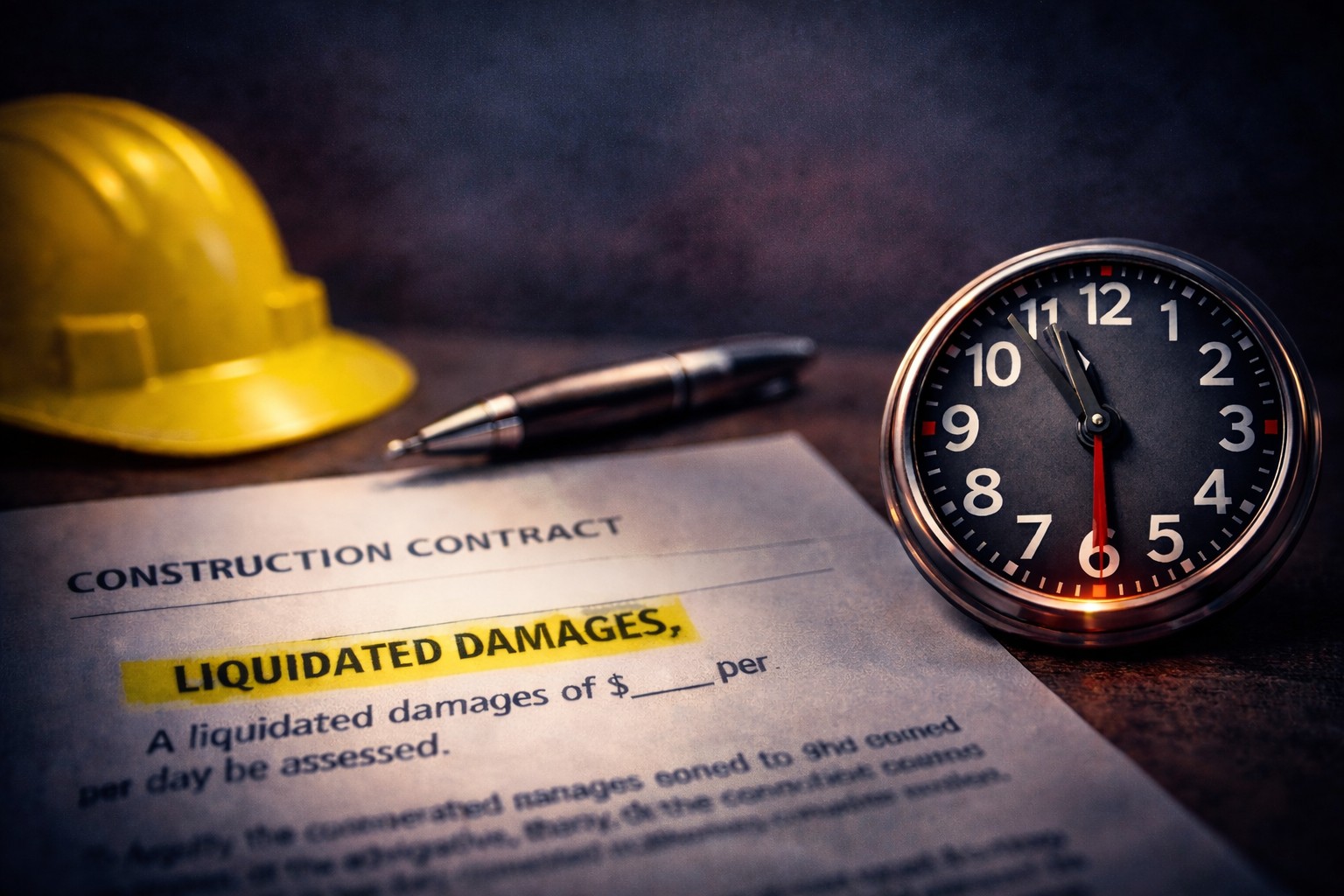
Thirty days from substantial completion, the owner pulls out the contract and points to a clause you signed six months ago: $5,000 per day in liquidated damages for every day you run over schedule. You are already three weeks behind. That is $105,000 walking out the door before you even finish the punch list. This scenario can indeed play out on Michigan construction projects. Most contractors who are hit with liquidated damages saw the clause in the contract when they signed it. Most of them did not fully understand what they were agreeing to
What are liquidated damages in a Michigan construction contract?
Liquidated damages are a contractually agreed-upon dollar amount, typically assessed on a daily basis, that a contractor owes the owner if the project is not substantially complete by a specified deadline. They are not a penalty; they are supposed to represent the parties’ best estimate, at the time of signing, of what a delay would actually cost the owner. Michigan courts may likely enforce them when they meet that standard.
Key Takeaways
- Liquidated damages clauses have been seen, and can be enforceable, in Michigan construction contracts.
- Michigan courts will not enforce an LD clause that functions as a penalty rather than a genuine pre-estimate of damages.
- The dollar amount, the deadline, and the definition of “substantial completion” all matter enormously.
- Contractors have specific defenses available, including owner-caused delays, concurrent delays, and waiver.
- You can negotiate LD clauses before signing. Many contractors do not try.
Why This Matters for Michigan Contractors
Michigan construction projects often run on tight margins. On a $2 million project with a 10% projected profit, the entire margin is $200,000. A liquidated-damages clause of $3,000 per day would consume that projected profit in about 67 days. On larger commercial projects, daily liquidated-damages rates of $5,000, $10,000, or more can appear, depending on the project and the owner’s estimated cost of delay
What makes this worse is that delays on construction projects are almost never entirely one party’s fault. Owners change orders. Design professionals issue late drawings. Material deliveries slip. Subcontractors fall behind. When delay happens, the owner looks to the LD clause first. Whether you can fight back depends entirely on what your contract says and what you documented along the way.
What Michigan Courts Require Before Enforcing an LD Clause
Michigan courts apply a two-part test before enforcing a liquidated damages clause. The clause must satisfy both elements.
First: Damages Must Be Difficult to Estimate at the Time of Contracting
If the owner could easily calculate the precise financial harm a one-day delay would cause, the LD clause loses much of its justification. But on most commercial projects, construction delays produce losses that are genuinely hard to pin down precisely: lost rental income, carrying costs, business interruption, financing costs, reputational harm. Michigan courts recognize this difficulty and generally find it satisfied on most commercial construction projects.
Second: The Amount Must Be a Reasonable Pre-Estimate of Actual Damages, Not a Penalty
This is where LD clauses get challenged. If the agreed daily amount bears no reasonable relationship to the actual losses the owner could expect from a delay, a Michigan court may refuse to enforce it as a penalty clause. The key word is “reasonable.” Courts look at what the parties knew or should have known at the time they signed, not what actually happened.
Are liquidated damages clauses enforceable in Michigan?
Yes, liquidated damages clauses are enforceable in Michigan if two conditions are met: (1) actual damages from a breach were difficult to estimate when the contract was signed, and (2) the agreed amount represents a reasonable pre-estimate of those damages rather than a punishment. A clause that functions as a penalty, bearing no reasonable relationship to anticipated harm, may be unenforceable.
The Clauses That Create the Most Risk
Not all LD clauses are created equal. These are the contract provisions that create the most exposure for Michigan contractors.
Vague or Missing Milestone Definitions
If the contract says LDs run until “completion” but never defines what completion means, you have a problem. Does completion mean substantial completion? Final completion? Certificate of occupancy? Each definition produces a different outcome. A contract that is silent on this point may give the owner the ability to run LDs for weeks after the project is functionally done.
No-Excuse Provisions
Some contracts include language that purports to hold the contractor liable for LDs regardless of the cause of delay, including owner-caused delays. Michigan courts do not look favorably on provisions that eliminate all contractor defenses, but the language still creates a fight you would rather not have.
Missing Float Allocation Language
On a project with a CPM schedule, float is a resource that belongs to someone. If the contract does not address who owns schedule float, the owner may claim it. That means any delay eats into the contractor’s schedule buffer before it even becomes an excusable delay event.
Asymmetric Provisions
Watch for contracts that impose LDs on the contractor for late completion but give the owner no corresponding obligation for late design deliverables, slow RFI responses, or restricted site access. Asymmetry in a contract can run against the contractor.
What is the difference between liquidated damages and a penalty in Michigan?
In Michigan, a liquidated damages clause is a binding agreement on a pre-estimated amount of harm. A penalty clause imposes an amount designed to punish or coerce, without regard to actual loss. Michigan courts will enforce the former and may refuse to enforce the latter. The distinction turns on whether the agreed amount was a reasonable estimate of anticipated damages at the time of contracting, not on what it is called in the contract.
Defenses Available to Michigan Contractors
If an owner asserts a liquidated damages claim, these are your most important defenses:
Owner-Caused Delay
If the owner contributed to the delay through late approvals, slow responses to RFIs, design changes, or restricted site access, you have grounds to seek a time extension and to argue that the LD clock should not run for owner-caused periods. This defense requires documentation. A paper trail of unanswered RFIs, change order requests, and schedule notices can be your best evidence.
Concurrent Delay
Where both parties contribute to a delay at the same time, Michigan courts may not award LDs to the owner for the concurrent period. The theory is that the owner cannot prove its own conduct was not responsible for the overrun. Establishing concurrent delay requires a detailed schedule analysis.
Waiver and Course of Conduct
If the owner knew about the contractor’s delayed schedule, accepted progress payments without objection, and never formally invoked the LD clause during the project, the owner may have waived the right to enforce it. Courts look at the parties’ conduct throughout the project, not just the language in the contract.
Penalty Clause Challenge
If the daily LD rate is grossly disproportionate to any harm the owner could reasonably have anticipated, challenge it. The burden is on the party seeking to avoid enforcement, but a clause set at an absurdly high amount gives you a legitimate argument.
Can a Michigan contractor fight a liquidated damages claim?
Yes. Common defenses include owner-caused delay, concurrent delay, waiver, and a challenge to the clause as an unenforceable penalty. Prevailing on any of these defenses typically requires contemporaneous documentation: RFI logs, change order requests, schedule updates, written notices, and meeting minutes. Contractors who document delays as they happen are in a far stronger position than those who try to reconstruct the record after the dispute begins.
How to Negotiate Liquidated Damages Clauses Before You Sign
Many contractors accept LD clauses without negotiating them. That is a mistake. Here is what you should address before you sign.
Ask for a cap.
Many sophisticated contractors negotiate a cap on total LD exposure, often expressed as a percentage of the contract price. A cap of 5% or 10% of the contract price significantly limits your worst-case outcome.
Define substantial completion clearly.
The contract should specify exactly what events constitute substantial completion and when the LD clock stops. Tie it to a specific, objective milestone, not a judgment call by the owner or architect.
Add an owner delay credit.
If the owner can assess LDs for contractor delays, the contractor should have the right to a time extension and, ideally, a day-for-day credit against LDs for any period of delay attributable to the owner.
Push for mutual delay provisions.
If the owner demands bonus or penalty provisions, make them mutual. If you finish early, you get a bonus. If the owner causes delay, the LD clock stops.
Identify excusable delay events explicitly.
Force majeure, supply chain disruptions, labor shortages, and government-ordered work stoppages should all be listed as events that extend the contract time without triggering LDs.
How should a Michigan contractor negotiate a liquidated damages clause?
Before signing, a contractor should seek a cap on total LD exposure (typically 5 to 10 percent of the contract price), a clear definition of substantial completion, explicit excusable delay provisions, and a day-for-day credit for owner-caused delays. At minimum, the contractor should understand the maximum financial exposure the clause creates before accepting the project at the proposed margin.
Contractor Takeaway: The Bottom Line
Liquidated damages clauses are not going away. They can often be found in many commercial construction projects in Michigan and are especially common on public projects in Wayne County, Oakland County, Macomb County, and Washtenaw County, where owners often want a defined daily remedy for delay. The question is not whether you will encounter them. It is whether you are prepared.
Three things give you the best protection. First, read and negotiate the clause before you sign. Know your maximum exposure going in. Second, document every delay event, every RFI, every change, and every notice as it happens. Third, if an owner asserts an LD claim that does not match the facts, get a Michigan construction attorney involved early. The sooner you engage counsel, the more options you have.
Frequently Asked Questions
Rates vary widely by project type and size. On smaller commercial projects, $500 to $1,500 per day is common. On larger commercial or industrial projects, $3,000 to $10,000 per day or more is not unusual. Public projects sometimes carry even higher daily rates. The rate must be reviewed in the context of the total contract price and the realistic project schedule.
LDs are typically imposed on the general contractor by the owner. Whether LDs flow down to subcontractors depends on the subcontract language. Subcontracts can include flow-down provisions that pass LD exposure to the sub whose work caused the delay. Subcontractors should review their subcontracts carefully for this language before signing.
Generally, no. A liquidated damages clause is typically the owner’s exclusive remedy for delay. In exchange for the certainty of a set amount, the owner gives up the right to prove higher actual damages. This can work in the contractor’s favor if actual delay damages exceed the LD amount.
Possibly not. If the owner accepted late completion without objection, accepted final payment without reserving LD claims, or otherwise acted in a way inconsistent with asserting LDs, the owner may have waived the right to collect them. The specific facts and the contract language matter significantly.
Contact a Michigan construction attorney immediately. An owner’s right to withhold payment for LDs depends on what the contract says and whether the LD claim is legitimate. In some cases, a wrongful withholding of payment can possibly give rise to a claim, including a claim under Michigan’s Builders Trust Fund Act, MCL 570.151 et seq.
Before you sign your next construction contract, make sure you understand your maximum LD exposure. A contract review now costs far less than a damages dispute later. Contact Szura & Delonis, PLC to schedule a consultation.
This article is provided for general educational and informational purposes only. It does not constitute legal advice and does not create an attorney-client relationship between the reader and Szura & Delonis, PLC. Michigan construction law involves complex statutory requirements and fact-specific analysis. Do not rely on this content as legal advice for your specific situation. If you have a time-sensitive construction law matter, consult a qualified Michigan construction attorney immediately.
About the Author
Richard M. Delonis is a Michigan construction, business, and real estate attorney at Szura & Delonis, PLC (Southfield/Metro Detroit). He advises construction managers, general contractors, subcontractors, and property owners on lien rights, collections strategy, contract disputes, and project-risk issues.

Address

Contact Us
Fill out the form or call us at (248) 716-3600 to reach us.
We Accept the Following Payment Solutions