




Michigan Builders Trust Fund Act: What Every Contractor and Subcontractor Needs to Know


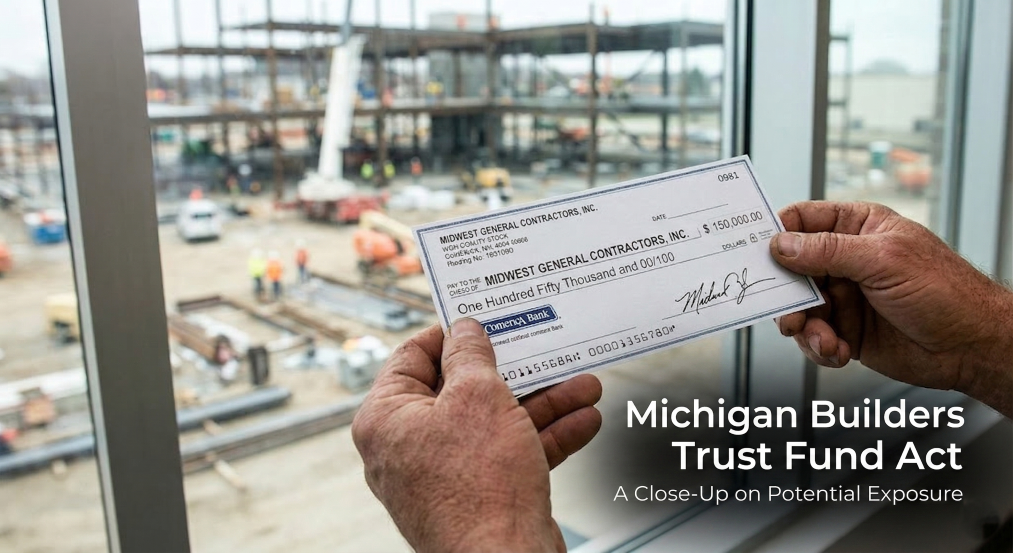
You finished the work. You sent the invoice. The general contractor cashed the owner’s check — and then your payment never came. Meanwhile, you have workers waiting to get paid and material suppliers calling your office. What you may not know is that in Michigan, the GC who pocketed those funds may have exposed itself, and possibly responsible individuals, to felony liability under Michigan law
Michigan’s Builders Trust Fund Act (MCL 570.151 et seq.) is one of the most powerful, and sometimes overlooked, statutes in Michigan construction law. It is not a lien law. It is a criminal statute that can make the intentional diversion or fraudulent misuse of construction funds a felony under Michigan law. And it is also a source of civil liability that subcontractors, suppliers, and laborers can use to recover money they are owed.
This article explains what the Builders Trust Fund Act does, who it covers, what violates it, and how both contractors and subcontractors should be using it to protect their interests on every Michigan project.
Summary
Michigan’s Builders Trust Fund Act (MCL 570.151 et seq.) requires contractors and subcontractors who receive construction funds to use those funds first to pay the subcontractors, suppliers, and laborers who worked on the project for which the money was paid. Intentional diversion or fraudulent retention/use of trust funds before paying protected parties can violate the Act and may support felony prosecution, this can include: paying overhead on another job, covering operating expenses, or diverting money to other uses. Unpaid subcontractors and suppliers can also pursue civil claims for misappropriation.
Key Takeaways
- Michigan’s Builders Trust Fund Act can impose felony consequences for intentional misuse or diversion of covered construction funds.
- The Act applies to both general contractors and subcontractors who receive construction funds at any tier of the payment chain.
- Using trust funds for anything other than paying the subcontractors, suppliers, and laborers on the specific project for which the money was received is a violation.
- Unpaid subcontractors and suppliers have both criminal complaint options and civil claims available.
- Contractors can protect themselves through dedicated project bank accounts, documented disbursement records, and proper payment procedures.
The Short Answer — What the Builders Trust Fund Act Does
Michigan’s Builders Trust Fund Act, codified at MCL 570.151 et seq., was enacted to protect subcontractors, suppliers, and laborers from a contractor who gets paid by the owner but fails to pass that money down the payment chain.
The core principle is simple: when a contractor receives money for a construction project, that money is not the contractor’s to spend freely. It is held in trust. The contractor is acting as a trustee, and the beneficiaries of that trust are the subcontractors, suppliers, and laborers who contributed labor or materials to that project.
Wrongfully diverting trust funds away from project-specific obligations can violate the Act and, depending on the circumstances, may support felony prosecution.
What is Michigan’s Builders Trust Fund Act?
Michigan’s Builders Trust Fund Act (MCL 570.151 et seq.) is a criminal statute that requires contractors and subcontractors who receive construction funds to hold those funds in trust for the subcontractors, suppliers, and laborers on the specific project for which the funds were paid. Misusing those funds is a felony under Michigan law and also gives rise to civil liability for the contractor and potentially its individual principals.
Who Does the Builders Trust Fund Act Apply To?
The Act applies broadly to contractors and subcontractors at every level of the construction payment chain. You do not have to be a general contractor to be subject to the Act. A subcontractor who receives payment from a GC and fails to pay its sub-subcontractors or material suppliers faces the same exposure.
The Act covers:
- General contractors who receive payment from project owners or developers
- Subcontractors of all tiers who receive payment from GCs or upper-tier subcontractors
The Act does not require formal trust documentation or a dedicated account. The trust obligation arises automatically by operation of law the moment construction funds are received. That is a critical point that many contractors miss.
Does the Builders Trust Fund Act apply to subcontractors, or just GCs?
The Michigan Builders Trust Fund Act applies to both general contractors and subcontractors. Any contractor or subcontractor who receives construction funds, at any tier of the payment chain, is required to hold those funds in trust for the subcontractors, suppliers, and laborers on the specific project for which the funds were received. The trust obligation arises automatically under MCL 570.151, not from any written agreement.
What Counts as a “Trust Fund” Under MCL 570.151?
Under the Act, funds received in payment for a Michigan construction project are trust funds from the moment of receipt. This generally includes project-specific funds paid to a contractor or subcontractor for the particular improvement:
- Progress payments from owners to GCs
- Draw disbursements from construction lenders (in some cases)
- Payments from GCs to subcontractors for work on a specific project
- Retainage releases attributable to a specific project
The trust obligation attaches to those specific funds and is tied to the specific project for which they were received. A GC who receives a $200,000 draw for Project A cannot use those funds to cover payroll for Project B, even if the company intends to repay the money later. Those funds must be applied consistently with the Act to project-specific obligations before they are diverted elsewhere.
What Violates the Builders Trust Fund Act?
A contractor violates the Act when it receives construction funds and intentionally uses those funds for a purpose other than paying the subcontractors, suppliers, and laborers on the project for which the funds were received. Common violations include the following.
Using Construction Funds for Overhead on Another Project
This is the most common violation pattern. A GC receives a draw on Project A, then uses those funds to cover payroll, subcontractor invoices, or material costs on Project B. Using Project A funds to cover Project B obligations creates serious exposure under the Act, even if the contractor intends to later replace the money.
Covering General Operating Expenses
Using construction funds to pay rent, insurance premiums, office staff, or other general overhead expenses while subcontractors remain unpaid on the project is a violation. The fact that the business was struggling financially is not a defense to a trust fund misappropriation claim.
Commingling Project Funds Creates Significant Risk
Commingling project-specific funds with general business operating accounts, and then spending from that account without ensuring project subcontractors are paid first, can create significant legal exposure. Depositing project funds into a general operating account is not, by itself, the statutory violation; the danger is that commingling makes diversion easier and proof problems much worse if protected parties remain unpaid. Michigan courts have found violations in cases where construction funds were deposited into operating accounts and then spent in ways that left subcontractors unpaid.
Paying Yourself Before Paying Subcontractors and Suppliers
A GC who pays its own overhead, profits, or management fees from construction funds before fully paying the subcontractors and suppliers on the project is walking directly into Builders Trust Fund Act exposure. The trust fund obligation runs first to the subcontractors, suppliers, and laborers who provided labor and materials.
What makes a contractor violate the Michigan Builders Trust Fund Act?
A contractor violates Michigan’s Builders Trust Fund Act (MCL 570.151) when it receives construction funds for a specific project and wrongfully diverts those funds away from subcontractors, suppliers, and laborers on that project. Violations can include diverting funds to cover overhead on other jobs, paying general business expenses, or commingling and spending funds before project subcontractors are paid.
Criminal Penalties
The Builders Trust Fund Act’s most significant feature is that it provides for criminal prosecution. Intentional misappropriation of covered construction trust funds can expose a contractor, and potentially responsible individuals, to felony charges under Michigan law.
The criminal dimension of the Act matters for several reasons:
- It creates potential criminal enforcement consequences beyond an ordinary civil payment dispute.
- A defrauded subcontractor or supplier can report suspected misconduct to appropriate law-enforcement or regulatory authorities.
- A felony conviction has consequences far beyond the specific construction dispute, such as contractor licensing, bonding capacity, banking relationships, and personal reputation are all at risk.
- Individual officers, members, and managers of construction companies who personally participate in or direct the diversion of trust funds can be held personally liable for trust fund misappropriation, not just the corporate entity.
For subcontractors and suppliers who are owed money, the criminal angle creates meaningful leverage. The prospect of a criminal investigation, and the reputational damage that comes with it, often motivates GCs to resolve payment disputes that they might otherwise contest or delay.
Civil Liability Under the Builders Trust Fund Act
In addition to criminal exposure, the Builders Trust Fund Act provides a basis for civil claims by unpaid subcontractors, suppliers, and laborers. A party that is owed money and can show that the contractor received construction funds and misappropriated them has a viable civil cause of action for trust fund misappropriation. A claimant does not need to wait for criminal charges to pursue civil remedies.
Civil claims under the BTFA offer several advantages over ordinary breach of contract litigation:
- The claim can be brought against individual officers and members of the contracting company, not just the entity, if they were responsible for the misappropriation.
- The BTFA civil claim can be combined with a Michigan construction lien claim, providing multiple enforcement pathways simultaneously.
- The combination of lien foreclosure and a BTFA civil claim gives unpaid subcontractors two independent legal tools: a lien against the property and a claim against the contractor and potentially its principals personally.
It is important to understand that a BTFA civil claim is separate from and in addition to a construction lien claim. An unpaid subcontractor who has properly perfected a Michigan construction lien under MCL 570.1101 et seq. has two independent legal tools available: lien foreclosure against the property and a BTFA civil claim against the contractor.
Can a subcontractor sue a GC under the Builders Trust Fund Act?
Yes. Michigan’s Builders Trust Fund Act (MCL 570.151) provides a basis for civil claims by unpaid subcontractors and suppliers against contractors who received construction funds and misappropriated them. A BTFA civil claim can be combined with a Michigan construction lien foreclosure action and may reach the individual officers or members of the contracting company personally, not just the corporate entity.
How Subcontractors and Suppliers Can Use the Builders Trust Fund Act
If you are a subcontractor or supplier who is owed money on a Michigan construction project, the Builders Trust Fund Act gives you tools beyond a lien.
Step 1 — Document the Payment Chain
Gather evidence that the owner or upper-tier contractor paid the party that owes you money. Payment applications, certified payrolls, draw schedules, and bank records can all establish that the trust funds were received. The key question is whether money came in and your payment did not go out.
Step 2 — Send Written Demand Referencing the BTFA
A written demand letter that specifically references the Builders Trust Fund Act and the contractor’s obligations under MCL 570.151 puts the GC on notice that you are aware of the statute. This often produces a faster response than a generic payment demand. Consult a Michigan construction attorney before sending demand letters that assert potential criminal liability.
Step 3 — Evaluate Criminal-Reporting Options with Counsel
If the contractor received payment and failed to pay you, you can file a complaint with law enforcement authorities. While criminal prosecution is not guaranteed, a pending investigation creates powerful incentive for resolution.
Step 4 — Pursue Civil Claims Concurrently
Work with a Michigan construction attorney to file civil claims for trust fund misappropriation alongside any lien foreclosure action. The combination of lien enforcement, BTFA civil claims, and a pending criminal complaint provides maximum leverage on a non-paying GC.
What can an unpaid Michigan subcontractor do under the Builders Trust Fund Act?
An unpaid Michigan subcontractor can: (1) send written payment demand citing MCL 570.151 and the contractor’s trust fund obligations; (2) file a criminal complaint for trust fund misappropriation; and (3) pursue civil claims for BTFA violations alongside a Michigan construction lien foreclosure action. These remedies are separate from and supplement lien rights under MCL 570.1101 et seq.
What Contractors Must Do to Stay Compliant
If you are a GC or subcontractor receiving construction funds on Michigan projects, here is how to protect yourself from Builders Trust Fund Act exposure.
Maintain Dedicated Project Bank Accounts
The single best risk management practice is to maintain a separate bank account for each significant project, or at minimum to track project funds separately from general operating funds. When trust funds are segregated, it is far easier to demonstrate that project funds were used for project obligations.
Pay Subcontractors and Suppliers Before Paying Overhead
When construction funds are received, prioritize payment to subcontractors, suppliers, and laborers on that project before using any portion for overhead, management fees, or other business expenses. Document every payment with date, amount, project reference, and payee.
Document Every Disbursement
Maintain contemporaneous records of how construction funds are received and disbursed. If the company is ever investigated or sued, detailed disbursement records are your primary defense. If records do not exist, it becomes very difficult to demonstrate that trust funds were properly applied.
Do Not Cross-Collateralize Projects
Using funds from Project A to cover obligations on Project B, with the intention of repaying from the next draw, is a potential violation of the Act. Each project’s funds must be treated independently.
Consult a Construction Attorney Before Withholding Disputed Funds
If you receive construction funds but a payment dispute arises — disputed change orders, backcharges, claims of defective work — consult a Michigan construction attorney before withholding or diverting any portion of those funds. There are proper procedures for handling disputed amounts. Unilaterally diverting funds while a dispute is pending can still create BTFA exposure. Not every payment dispute, offset, or backcharge becomes a Builders Trust Fund Act violation, but using received project funds for non-project purposes before protected claimants are paid can create serious legal risk.
Why This Matters for Metro Detroit Contractors
Michigan’s construction industry operates on thin margins and compressed project timelines. On major commercial and institutional projects across Oakland County, Wayne County, and Macomb County, the payment chain runs from developer to GC to multiple tiers of subcontractors and suppliers. A payment failure at any level sends immediate shock waves down the chain.
The Builders Trust Fund Act exists precisely because ordinary breach of contract remedies are sometimes too slow and too expensive to protect the subcontractors and suppliers who are most vulnerable to payment failure. The criminal dimension of the Act, and the ability to reach individual owners and officers personally, gives it teeth that a simple civil lawsuit often lacks.
For Metro Detroit GCs and subcontractors, understanding the Act is not optional. It is a basic element of operating a compliant and financially sound construction business in Michigan.
Contractor Takeaway
Michigan’s Builders Trust Fund Act (MCL 570.151 et seq.) is not an obscure technical statute. It is an active enforcement tool with real criminal teeth. If you receive construction funds on a Michigan project, those funds belong to the subcontractors, suppliers, and laborers on that project. Not to your general business. Wrongful diversion of those funds can create felony exposure and civil liability; it is far more than an ordinary payment dispute. If you are a subcontractor who is not getting paid, the BTFA gives you remedies beyond a lien: a criminal complaint and a civil claim against the contractor and potentially its principals individually. Do not wait. Contact a Michigan construction attorney at the first sign of payment problems.
Frequently Asked Questions: Michigan Builders Trust Fund Act
What is the Michigan Builders Trust Fund Act?
Michigan’s Builders Trust Fund Act (MCL 570.151 et seq.) is a statute that requires contractors and subcontractors who receive construction funds to hold those funds in trust for the subcontractors, suppliers, and laborers on the specific project for which the money was paid. Intentionally misusing those funds is a criminal violation that can result in felony prosecution.
Is violating the Builders Trust Fund Act really a felony in Michigan?
Yes. Michigan’s Builders Trust Fund Act provides for criminal prosecution, including felony charges, for intentional misappropriation of construction funds. Individual officers and members of contracting companies can be prosecuted personally, not just the business entity. The severity of the criminal charge depends on the facts and circumstances of the misappropriation.
Does the Builders Trust Fund Act apply to subcontractors, or only to GCs?
The Act applies to both general contractors and subcontractors. Any party who receives construction funds at any tier of the payment chain holds those funds in trust for the parties below them who provided labor and materials on the same project. A subcontractor who is paid by a GC and fails to pay its sub-subcontractors or suppliers faces the same legal exposure as a GC who fails to pay subcontractors.
Can I file a criminal complaint if my GC is not paying me?
Yes. Unpaid subcontractors and suppliers can file complaints with law enforcement for Builders Trust Fund Act violations. They may investigate contractors who receive construction funds and fail to pay their project subcontractors and suppliers, and refer them to the prosecutor. A Michigan construction attorney can advise you on the process and how it interacts with your civil remedies.
How does the Builders Trust Fund Act work with my Michigan construction lien?
The Builders Trust Fund Act and Michigan’s Construction Lien Act (MCL 570.1101 et seq.) are independent legal tools that can be used simultaneously. A lien encumbers the property and must be foreclosed in circuit court. A BTFA claim can be brought against the contractor, and potentially its principals personally, in a civil lawsuit. An unpaid subcontractor may wish to pursue both remedies concurrently to maximize leverage and recovery options.
This blog post is for general educational purposes only and does not constitute legal advice. Michigan construction law is complex and fact-specific. No attorney-client relationship is created by reading this article. Contact Szura & Delonis, PLC at (248) 716-3600 for advice on your specific situation.
About the Author
Richard M. Delonis is a Michigan construction, business, and real estate attorney at Szura & Delonis, PLC (Southfield/Metro Detroit). He advises construction managers, general contractors, subcontractors, and property owners on lien rights, collections strategy, contract disputes, and project-risk issues.

Address

Contact Us
Fill out the form or call us at (248) 716-3600 to reach us.
We Accept the Following Payment Solutions