



Michigan’s Homeowner Energy Policy Act: What Every HOA Board Needs to Know in 2026


Michigan’s Homeowner Energy Policy Act (MCL 559.301 et seq.) took effect on April 1, 2025, fundamentally changing how homeowner associations can regulate solar panels and energy-saving improvements. If your HOA board has not yet adopted a compliant solar energy policy, the April 1, 2026 deadline is approaching fast—and the consequences of non-compliance include potential civil liability and the loss of your ability to regulate installations at all.
For Michigan HOA boards, the Homeowner Energy Policy Act (HEPA) represents one of the most significant regulatory changes in years. The law invalidates blanket bans on solar panels, requires associations to adopt detailed written policies, and creates new application and approval procedures that boards must follow precisely.
This comprehensive guide explains what the law requires, what your board can and cannot do, and the specific steps you should take now to ensure compliance and protect your community.
What Is the Homeowner Energy Policy Act?
The Homeowner Energy Policy Act (Public Act 68 of 2024) was signed by Governor Whitmer on July 8, 2024, and became effective April 1, 2025. The Act limits homeowner associations’ authority to prohibit or restrict members from installing energy-saving improvements on their properties.
The law applies to two categories of installations: (1) solar energy systems, which are subject to detailed regulations, and (2) other energy-saving improvements, which associations generally cannot prohibit at all.
Energy-Saving Improvements That Cannot Be Prohibited
Under MCL 559.305, any HOA provision that prohibits—or requires association approval for—the following improvements is invalid and unenforceable:
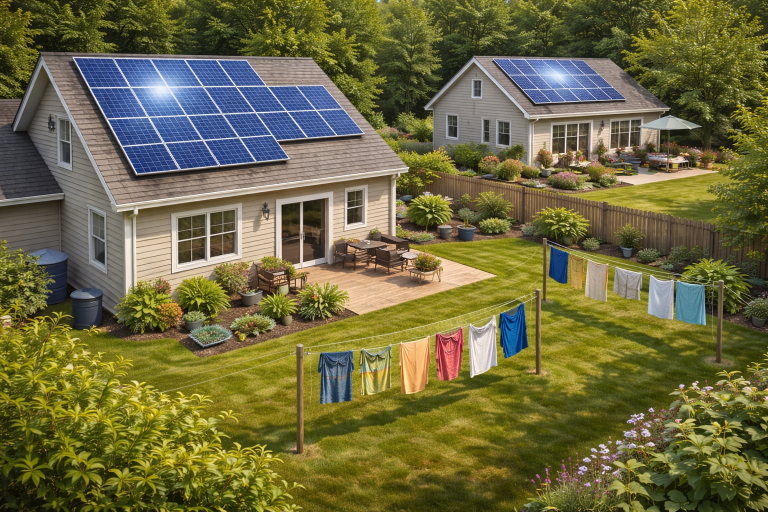
- Clotheslines
- Air source and ground source heat pumps
- Insulation upgrades
- Rain barrels
- Reflective roofing
- Energy-efficient appliances
- Solar water heaters
- Electric vehicle charging equipment
- Energy-efficient windows
This means your existing deed restrictions, bylaws, or architectural guidelines that prohibit these items are now void as a matter of Michigan public policy—regardless of what your governing documents say.
Solar Energy Systems: What HOAs Can Still Regulate
While HEPA prohibits outright bans on solar panels, the law does preserve certain regulatory authority for associations. HOA boards can still review solar panel applications and enforce reasonable aesthetic standards—but those standards must meet specific statutory requirements.
Grounds for Denying a Solar Panel Application
Under MCL 559.309, an HOA may deny a solar energy system application only if one or more of the following conditions apply:
Court Finding of Legal Violation: A court has found that the installation violates a law.
Non-Conformance with Approved Application: The installed system does not substantially conform with the application that was approved.
Roof Installation Standards: For roof-mounted systems, the association may deny if: the system extends more than 6 inches above or beyond the roof; the system does not conform to the roof slope with a top edge parallel to the roof line; or the frame, brackets, or visible conduit/wiring are not silver, bronze, or black tone (colors commonly available in the marketplace).
Ground Installation Standards: For ground-mounted systems in a fenced yard or patio, the association may deny if the system is taller than the fence line.
Critical Limitations on HOA Authority
The Act imposes strict limits on what standards an HOA can enforce. Any policy standards that reduce estimated annual energy production by more than 10% or increase installation costs by more than $1,000 are prohibited. Additionally, HOAs cannot:
- Prohibit solar panels from being installed on any roof face
- Require a specific technology (such as solar shingles instead of traditional panels)
- Inquire into a member’s energy usage
- Impose conditions that impair system operation or void industry standard warranties
- Require post-installation reporting
- Charge higher application fees than for other property modification requests
- Deny applications based on who owns the system or the financing method chosen
The Mandatory Solar Energy Policy: Requirements and Deadline
Under MCL 559.309(1), every Michigan homeowner association must adopt a written solar energy policy statement within one year of the Act’s effective date. The deadline is April 1, 2026.
Required Policy Provisions
The policy must include specific statements required by statute, including affirmations that the association will not engage in any of the prohibited conduct listed above, that adjacent owner approval is not required for solar installations, and that members may resubmit denied applications for reevaluation under the new law.
The policy must also clearly state the grounds on which an application may be denied and the application requirements members must follow.
Distribution Requirements
Once adopted, the association must provide a copy of the policy to all members within 30 days, make it available upon request, and post it on the association’s website if one exists.
Application and Approval Procedures
Under MCL 559.311, members who wish to install a solar energy system must submit a written application containing: the member’s name; the street address where the system will be installed; the name and contact information of the installer; an image showing the proposed layout; and a description of the system.
The association must approve or deny the application within 30 days after the policy is adopted. For applications submitted before the policy is adopted, the association has 120 days to respond.
Importantly, if the association fails to adopt a policy by the deadline or fails to respond to an application within the required timeframe, the member may proceed with installation and the association cannot impose fines or penalties.
Does the Act Apply to Condominium Associations?
One significant issue with HEPA is that the legislature did not define “homeowner association.” This has created uncertainty about whether the Act applies to condominium associations governed by the Michigan Condominium Act (MCL 559.101 et seq.).
The Michigan legal community is divided on this question. Some attorneys argue that because the legislature knows how to distinguish between HOAs and condominium associations in other statutes—and chose not to include condominium associations in HEPA—the Act should not apply to condos. Others contend that condominium associations should voluntarily comply to avoid potential liability until courts provide clarity.
Regardless of this uncertainty, the Act clearly does not apply to shared roofs (roofs serving more than one unit) or common areas. This means most traditional high-rise or attached condominium projects with shared roofs would not be subject to the solar panel provisions even if courts determine the Act applies to condominiums generally.
Enforcement and Penalties
HEPA includes meaningful enforcement mechanisms. Under MCL 559.315, if an association violates the Act, a member may bring a civil action for damages. A prevailing member may recover reasonable attorney fees and costs—making non-compliance a potentially expensive proposition for associations.
Additionally, any provision in an HOA policy that conflicts with the Act is automatically void and unenforceable.
Action Steps for HOA Boards
To ensure compliance and protect your association, boards should take the following steps before the April 1, 2026 deadline:
1. Review Existing Governing Documents: Identify any provisions that prohibit or restrict energy-saving improvements or solar panels. These provisions are now unenforceable and should be addressed in future amendments.
2. Adopt a Compliant Solar Energy Policy: Work with legal counsel to draft a policy that includes all required statutory provisions and stays within the bounds of what the Act permits.
3. Update Application Procedures: Ensure your architectural review or modification application process can accommodate solar panel requests within the 30-day response window.
4. Distribute the Policy: Provide copies to all members within 30 days of adoption and post it on your website.
5. Train Board Members and Managers: Ensure everyone involved in reviewing applications understands the new requirements and limitations.
Michigan’s Homeowner Energy Policy Act requires careful attention to statutory requirements and deadlines. We regularly advise Michigan HOA and condominium boards on compliance with state law, including drafting compliant solar energy policies, reviewing and amending governing documents, and counseling boards on application review procedures.
If your board needs assistance preparing for the April 1, 2026 deadline, or if you have questions about how HEPA affects your community, contact our office at (248) 716-3600 to schedule a consultation.
Frequently Asked Questions About the Michigan Homeowner Energy Policy Act
No. Under the Homeowner Energy Policy Act (MCL 559.307), any HOA provision that prohibits solar panel installation is invalid and unenforceable as contrary to Michigan public policy. However, associations can still enforce reasonable aesthetic standards that meet statutory requirements.
Michigan HOAs must adopt a compliant written solar energy policy by April 1, 2026—one year after the Act’s effective date.
If the association fails to approve or deny your application within 30 days (or 120 days if submitted before the policy was adopted), you may proceed with installation and the HOA cannot impose fines or penalties.
The statute does not clearly define “homeowner association,” creating uncertainty about whether it applies to condominium associations. However, the Act clearly does not apply to shared roofs or common areas, exempting many traditional condominium configurations.
Your HOA cannot charge a higher fee for solar panel applications than it charges for other property modification requests.
Disclaimer: This article provides general information about Michigan’s Homeowner Energy Policy Act and does not constitute legal advice. The application of law to specific circumstances requires individual analysis. Contact a qualified attorney for advice regarding your association’s particular situation.
About the Author
Richard M. Delonis is a Michigan condominium and HOA lawyer at Szura & Delonis, PLC in Southfield (Metro Detroit). He advises association boards and community association managers on governance, rule enforcement, assessment collections, document amendments, and risk management, with a practical focus on helping boards reduce disputes and run defensible, well-documented processes.
Address

Contact Us
Fill out the form or call us at (248) 716-3600 to reach us.
We Accept the Following Payment Solutions